
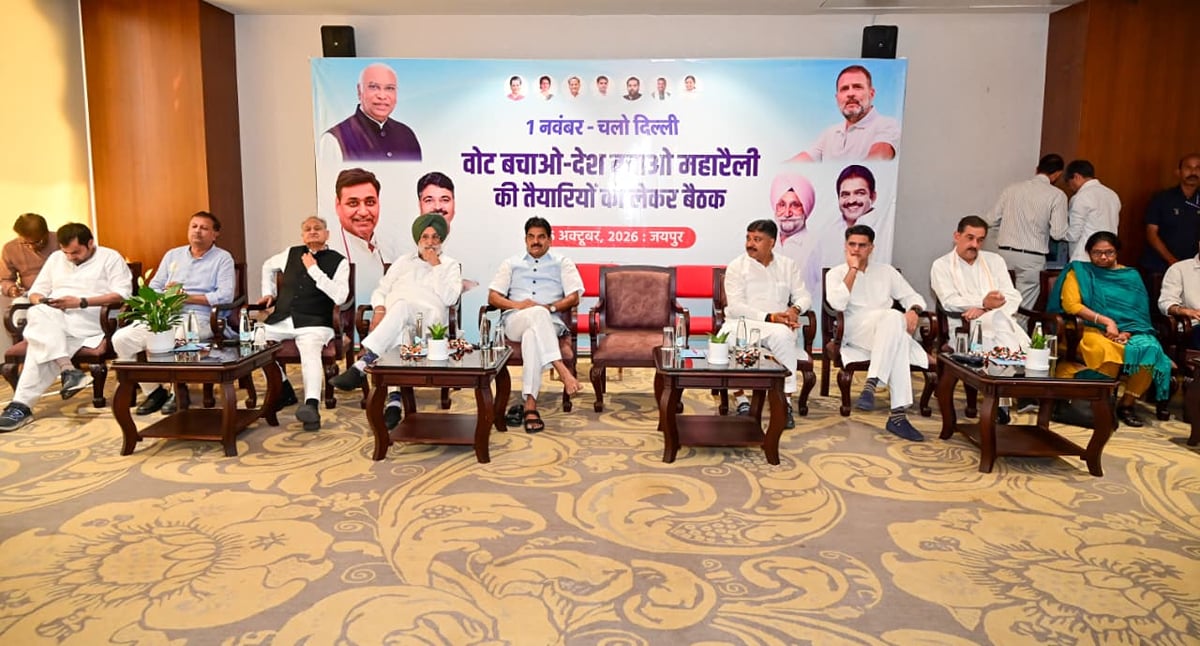
In a significant organizational directive, the Rajasthan unit of the Indian National Congress has instituted rigorous verification and documentation protocols to monitor the exact magnitude of mobilization for the upcoming political rally in Delhi. The leadership has mandated that every single contingent traveling from the state must be subjected to thorough documentation, ensuring absolute transparency and accountability in the reporting of party workers. This unprecedented administrative step marks a departure from traditional estimation methods, replacing rough estimates with verifiable empirical data.
Historically, political rallies organized in the national capital have relied on generalized estimates and subjective reports regarding crowd sizes submitted by various local functionaries. However, the current directive issued within the party structure aims to eliminate discrepancies and establish a foolproof mechanism to gauge grassroots participation accurately. By introducing systematic data collection, the party intends to present an objective assessment of organizational strength and outreach directly to the higher echelons of leadership.
The operational framework of this directive involves multi-tiered monitoring at strategic transit points across Rajasthan. Party functionaries have been instructed to ensure that every vehicle utilized for transporting workers is properly documented. This includes recording specific registration numbers of buses, cars, and other transit modes, alongside capturing continuous video footage of the caravans as they depart and traverse toward the destination. Furthermore, physical headcounts of the workers boarding these vehicles will be conducted to maintain precise numerical tallies.
Local party coordinators, district leaders, and logistics managers have expressed mixed reactions regarding the rigorous implementation of these guidelines. While administrative purists view this as a progressive measure to ensure discipline and resource optimization, grassroots organizers note that managing detailed headcounts alongside vehicular documentation presents unique logistical challenges. Nevertheless, strict compliance has been emphasized across all participating districts to ensure that no discrepancies arise during the compilation of the final reports.
The impact of this rigorous monitoring extends directly to regional transport corridors and local communities within Rajasthan, as massive convoys mobilize toward the national capital. Transport operators, local businesses, and regional party offices are witnessing heightened activity levels as coordination committees finalize the deployment of vehicles. The meticulous tracking ensures that logistical planning matches the actual on-ground presence, thereby streamlining movement through key transit routes and minimizing disruption to general public traffic.
Administrative committees constituted specifically for this purpose are overseeing the seamless execution of the tracking mechanism. These committees are tasked with compiling the video evidence, vehicle registration logs, and headcount sheets into a comprehensive dossier. The deployment of systematic verification protocols reflects an evolving approach toward internal management, emphasizing accountability and verifiable metrics over traditional estimation practices within political organizational structures.
As the final departure schedules approach, all district units are directed to finalize their preparations strictly in accordance with the mandated guidelines. The compiled reports containing the exhaustive details of vehicles and worker numbers will be formally transmitted to the party high command immediately following the culmination of the Delhi event. This data-driven approach is expected to set a new internal benchmark for evaluating mass mobilization and grassroots engagement in future political undertakings across the state.
