
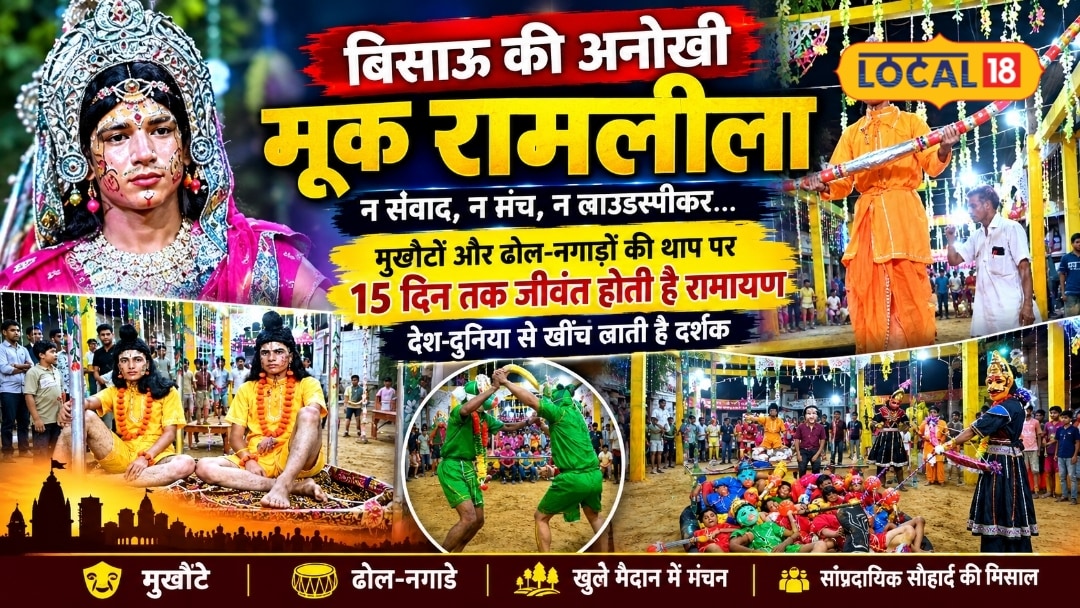
In the Bisaou town of the Jhunjhunu district in Rajasthan, a remarkable cultural tradition has endured for an extraordinary 180 years, captivating audiences through a medium entirely devoid of spoken words. Known widely as a unique silent Ramlila, this grand production breaks away from conventional theatrical norms observed across the nation. Instead of relying on script dialogues or dramatic vocal outbursts, the entire narrative is meticulously communicated through physical expressions, traditional masks, and the rhythmic beats of drums and percussion instruments.
Tracing its roots deep into the historical tapestry of the region, this 180-year-old traditional staging has preserved a distinct artistic identity that sets it apart from all other iterations of the epic. The longevity of this custom underscores the unwavering commitment of the local populace in the Jhunjhunu district to safeguard their ancestral heritage. Generations of performers have handed down the subtle nuances of facial expressions, body language, and timed movements, ensuring that the essence of the epic remains vibrantly alive without uttering a single syllable.
The logistical framework and operational timeline of this grand event span approximately 15 days, commencing strictly from Ashwin Shukla Pratipada and culminating on Purnima. Every single day of these 15 days is marked by meticulous preparations, community participation, and large-scale gatherings that transform the Bisaou town into a vibrant cultural hub. The financial and organizational efforts are sustained through collective community involvement, drawing spectators, researchers, and cultural enthusiasts from neighboring regions to witness this fascinating theatrical phenomenon.
Local organizers, community elders, and cultural custodians emphasize that the absence of dialogues enhances the spiritual and meditative aura of the performance, compelling audiences to concentrate deeply on the symbolic actions of the actors. Participants who don the traditional masks undergo rigorous rehearsals to master the precise gestures required to convey complex emotions of devotion, valor, and conflict. The rhythmic coordination with traditional drumbeats serves as the auditory anchor, guiding the emotional highs and lows of the dramatic enactment seamlessly across the sprawling venue.
While standard Ramlila celebrations across the country traditionally culminate in the effigy burning of Ravana on Vijayadashami, the Bisaou tradition strictly follows its own distinct calendar and ritualistic timeline. In this specific Jhunjhunu town celebration, the ceremonial slaying of Ravana is deliberately scheduled not on Dussehra, but rather on Chaturdashi. This chronological deviation highlights the profound autonomy of local customs and adds a layer of deep historical significance to the concluding phases of the 15-day festival.
Administrative bodies and local authorities coordinate closely during the festival window to manage the massive influx of visitors converging upon the Bisaou town. Traffic regulations, security arrangements, and crowd management protocols are meticulously implemented by local administration officials to ensure the smooth progression of the fortnight-long festivities. The seamless cooperation between the organizing committees and civic authorities reflects a shared dedication to upholding public safety while respecting deeply ingrained religious and cultural practices.
Looking toward the future, the custodians of this 180-year legacy remain steadfast in their mission to transmit this rare art form to younger generations without altering its foundational elements. Plans are continually evaluated to document the performances comprehensively, thereby preserving the intricate details of the mask-making traditions, drum rhythms, and silent acting techniques for posterity. As the 15-day celebration advances each year from Ashwin Shukla Pratipada to Purnima, the community of Bisaou continues to stand as a proud guardian of an irreplaceable cultural treasure.
