
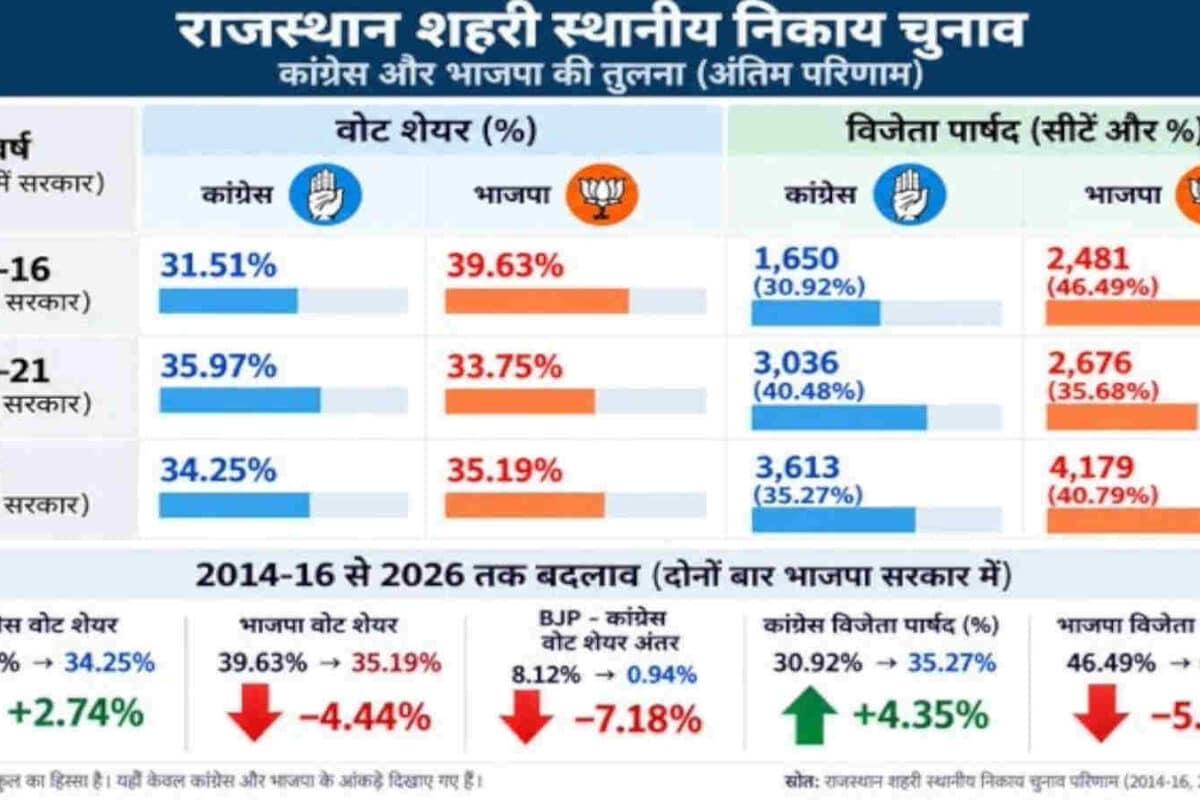
The 2026 local body elections across Rajasthan concluded last week, delivering a mixed verdict for the two dominant national parties. While the Bharatiya Janata Party (BJP) emerged as the front‑runner, the Indian National Congress (INC) remained within striking distance, trailing by a mere one‑percent margin in overall vote share. The result has been widely interpreted as a pre‑lude to the state’s upcoming panchayat elections, where both parties are poised to contest a vast network of village‑level institutions that directly influence daily life for millions of residents.
Historically, Rajasthan’s local body polls have served as a litmus test for broader political currents. The state’s first structured municipal and panchayat elections were held in the early 1990s, and since then, the contests have evolved into a complex tapestry of caste dynamics, development narratives, and party‑level organisational strength. In the previous cycle of 2021, the BJP secured a comfortable lead, but the Congress managed to close the gap in several districts, setting the stage for a fiercely contested 2026 round.
On the ground, the election machinery mobilised thousands of polling stations, deploying a cadre of election officials, security personnel, and volunteers to ensure smooth conduct. While precise seat counts remain under official verification, preliminary data confirm that the Congress’s vote share is only one percentage point behind that of the BJP. Financially, both parties invested heavily in campaign logistics, ranging from transportation of candidates to the distribution of printed manifestos, reflecting the high stakes attached to control over local governance structures.
Party spokespeople articulated divergent narratives in the immediate aftermath. A senior BJP representative emphasised the party’s continued resonance with rural voters, citing development projects and infrastructure promises. Conversely, a Congress leader highlighted the narrow margin as evidence of a resurging public mood, asserting that the party’s grassroots outreach will translate into a decisive advantage in the forthcoming panchayat polls. Local traders and farmers, who turned out in large numbers, expressed cautious optimism, noting that effective local administration could directly impact market access and agricultural support.
For the Kotputli‑Behror district, the election outcome carries particular significance. The region, characterised by a blend of agrarian communities and emerging industrial zones, has long grappled with water scarcity, road connectivity, and employment challenges. A BJP‑led local body could accelerate ongoing infrastructure projects, while a Congress‑influenced council might prioritise agrarian subsidies and skill‑development programmes. Residents anticipate that whichever party gains control will shape the district’s developmental trajectory over the next five years.
The State Election Commission, tasked with overseeing the entire process, has announced a comprehensive audit of the results before certifying the final figures. Security forces remain on standby to address any isolated incidents, and the commission has pledged transparency through public disclosure of constituency‑wise vote counts. Additionally, civil‑society watchdogs have called for stricter enforcement of the Model Code of Conduct as the panchayat elections approach.
Looking ahead, the panchayat elections are slated for early 2027, with the Election Commission expected to release a detailed schedule within the next two months. Both the BJP and Congress are already mobilising their organisational networks, preparing manifestos that address local concerns such as irrigation, education, and health services. Analysts predict that the narrow one‑percent gap observed in the recent local body results will intensify competition, making the upcoming polls a decisive battleground for political momentum in Rajasthan.