
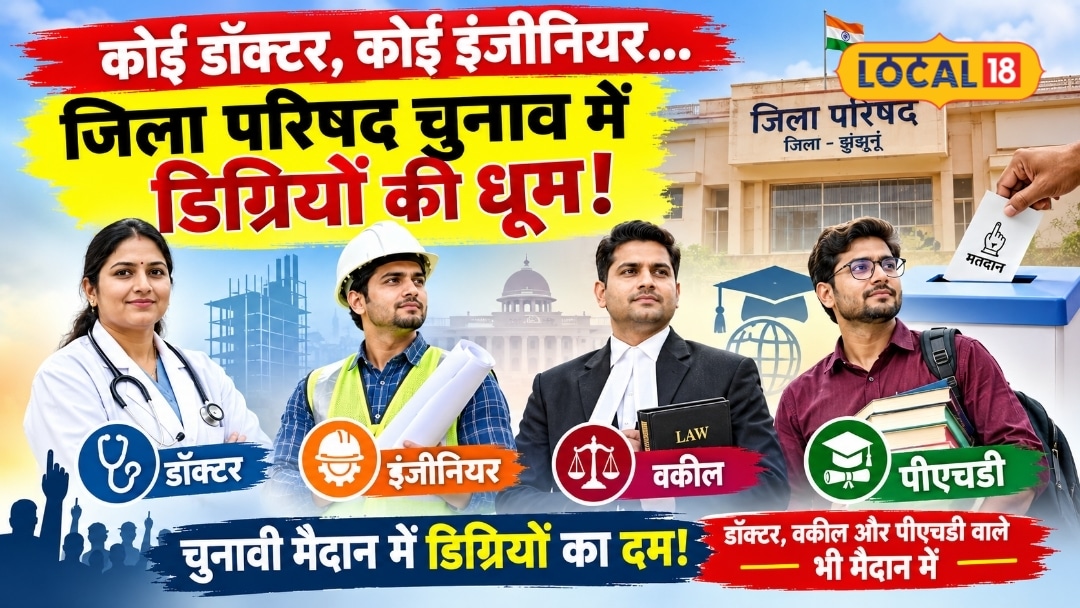
The political landscape of the region is witnessing a notable transformation as the Jhunjhunu Zila Parishad elections for the year 2026 officially commence. A total of 158 candidates are fiercely contesting across 41 wards, turning the local electoral battle into a subject of profound public discussion regarding educational qualifications, professional backgrounds, and declared assets. This year's candidate pool reflects a departure from conventional political demographics, incorporating high-profile professionals into grassroots administration.
Historically, local administrative elections have been dominated by traditional political families and long-standing community leaders. However, the 2026 election cycle in Jhunjhunu has broken conventional molds by attracting a diverse spectrum of society. The origin of this shift lies in an increasing public demand for educated leadership capable of understanding complex financial allocations, developmental schemes, and statutory frameworks necessary for modern rural transformation.
An analysis of the 158 candidates reveals a fascinating socio-economic cross-section of the district. The electoral arena now features trained doctors, legal professionals, and engineers who have chosen to leave their private practices and corporate desks to serve rural communities. Furthermore, the statistics highlight the active participation of approximately 70 homemakers and 40 farmers, ensuring that domestic management and agrarian realities are robustly represented in the upcoming council discussions.
Financial declarations submitted by the candidates have added another layer of intrigue to the 2026 Zila Parishad elections. Stark economic contrasts are evident across the wards, exemplified by Rajkumar from Ward 33, who stands out as the wealthiest contender with declared assets totaling 4.52 crore rupees. Conversely, candidates like Rahul Jakhar represent the opposite end of the spectrum, reporting modest declared assets of merely 55 thousand rupees, underscoring the democratic accessibility of the electoral process.
Beyond wealth and profession, a tremendously encouraging statistic defines the 2026 elections in Jhunjhunu: more than 95 percent of all participating candidates possess an entirely clean record with no pending criminal cases. This overwhelming absence of legal encumbrances has been widely welcomed by local residents, trade bodies, and civic observers who view it as a vital step toward transparent, accountable, and progressive local governance.
District administrative authorities have ensured rigorous oversight of the nomination, verification, and campaigning phases to maintain absolute compliance with electoral guidelines. Officials have streamlined the declaration of assets and educational credentials to ensure complete transparency for voters. Administrative monitoring teams remain deployed across all 41 wards to guarantee a peaceful, fair, and orderly electoral environment throughout the district.
As the campaign moves toward its decisive phase, public expectations remain remarkably high regarding the potential outcomes of the 2026 Zila Parishad elections. Observers and citizens alike anticipate that the convergence of doctors, lawyers, engineers, farmers, and homemakers will fundamentally elevate the standard of public debate and policy execution. The upcoming administration faces the critical responsibility of transforming these high educational credentials and clean profiles into tangible developmental milestones for the entire region.
