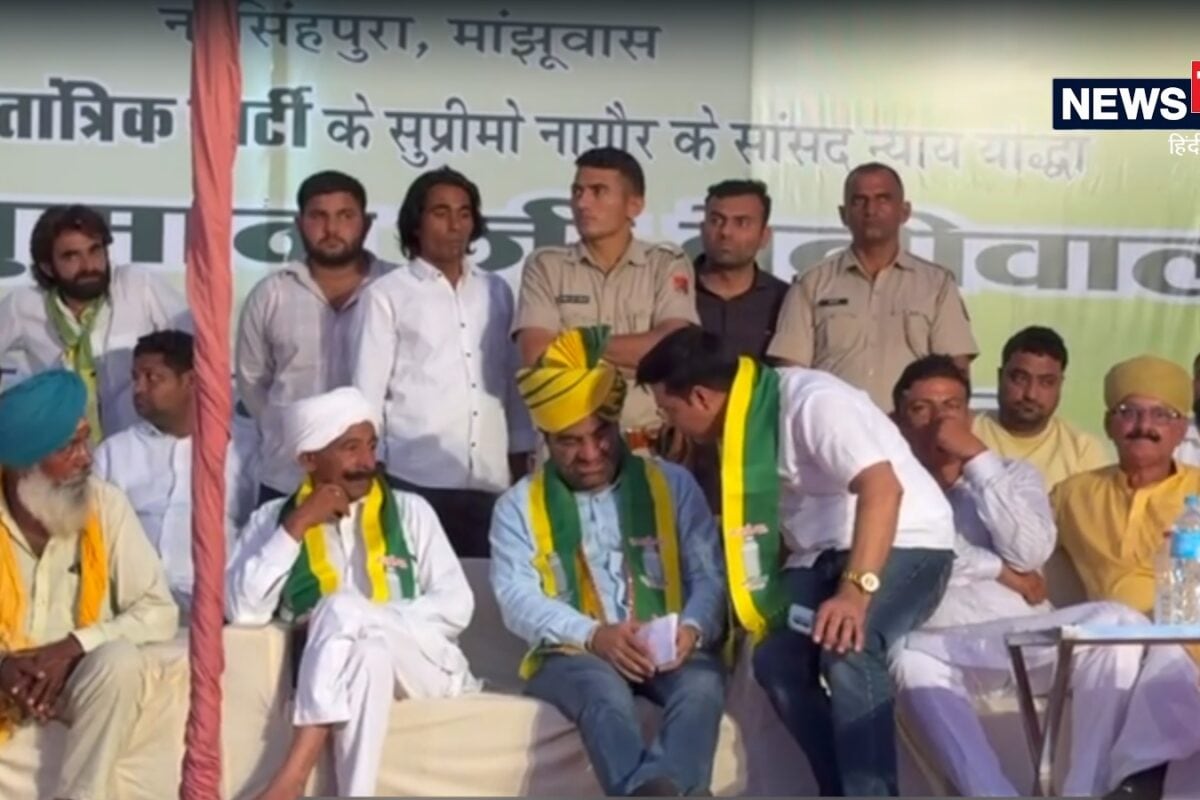
The tranquil region of Narsinhpura Barani in Sriganganagar has emerged as the epicenter of a severe administrative standoff as opposition to the newly proposed garbage processing facility intensifies. Local residents have maintained a steadfast posture against the installation of the municipal waste plant in their immediate residential and agricultural vicinity, leading to months of uninterrupted agitations and persistent sit-in demonstrations across the area. The controversy escalated substantially when Rashtriya Loktantrik Party (RLP) supremo Hanuman Beniwal stepped directly into the arena to spearhead the agitation and unite the protesting villagers under a single banner.
To contextualize the ongoing civil unrest, the genesis of this prolonged agitation traces back to several months ago when preliminary announcements regarding the establishment of the garbage treatment facility in Narsinhpura Barani first surfaced. Residents contend that the chosen geographical location is utterly unsuitable for waste management operations due to its proximity to populated settlements and agricultural lands, which they fear will severely compromise local sanitation, underground water purity, and overall public health. Despite repeated appeals submitted to various local functionaries, the lack of a reassuring dialogue from municipal authorities forced the community to institutionalize their resistance through continuous democratic sit-ins.
The ground reality reflects profound anxieties among the rural populace regarding the long-term ecological and infrastructural viability of executing such a heavy-duty industrial project near residential clusters. While formal municipal statistics or specific financial outlays regarding the plant construction have faced severe skepticism from the local community, the primary bone of contention remains the sheer disregard for local habitation patterns. Farmers and daily-wage earners alike have expressed deep apprehension that the inflow of untreated municipal waste would ruin the ambient environment, thereby negatively transforming the socio-economic and agrarian fabric of Narsinhpura Barani and surrounding localities.
Voicing deep solidarity with the distressed populace, RLP supremo Hanuman Beniwal addressed a massive public assembly, known locally as a Mahapanchayat, where thousands of determined citizens gathered to register their unified protest. During the massive congregation, stakeholders articulated their uncompromising stance, stating categorically that the establishment of the garbage plant would not be permitted under any circumstances. Community leaders, village elders, and local representatives reiterated that their peaceful protests would transform into aggressive state-wide demonstrations if the administration continues to ignore their legitimate democratic grievances and environmental concerns.
The reverberations of this intense standoff extend far beyond the immediate boundaries of Narsinhpura Barani, drawing significant attention from neighboring regions and administrative districts. Observers note that municipal waste management policies across Rajasthan frequently encounter severe implementation roadblocks due to a lack of consensus-building and transparent site selection protocols. The current agitation in Sriganganagar serves as a critical barometer of how rural communities are increasingly asserting their constitutional right to a clean, safe, and sustainable environment, compelling regional authorities to rethink top-down developmental models that bypass grassroots consultations.
Responding to the mounting pressure, local administrative machinery and district-level authorities are currently reviewing the security and logistical implications of the ongoing protests. While official statements from municipal bodies have emphasized the necessity of expanding urban waste disposal infrastructure to manage burgeoning city garbage, they have struggled to present a viable mitigation framework that satisfies the protesting residents of Narsinhpura Barani. Pressure is rapidly mounting on civil servants and elected officials to mediate a constructive dialogue before the situation deteriorates further into widespread civil disobedience.
Looking toward the immediate future, the timeline set by the RLP leadership and local villagers leaves very little room for administrative complacency. Hanuman Beniwal's explicit ultimatum—threatening a massive highway blockade if the project is not immediately scrapped or relocated—has put the local police and district administration on high alert. As public expectation mounts and community resolve hardens, all eyes remain fixed on how the Sriganganagar district administration will navigate this high-stakes deadlock without triggering a major disruption of public transport and law and order.