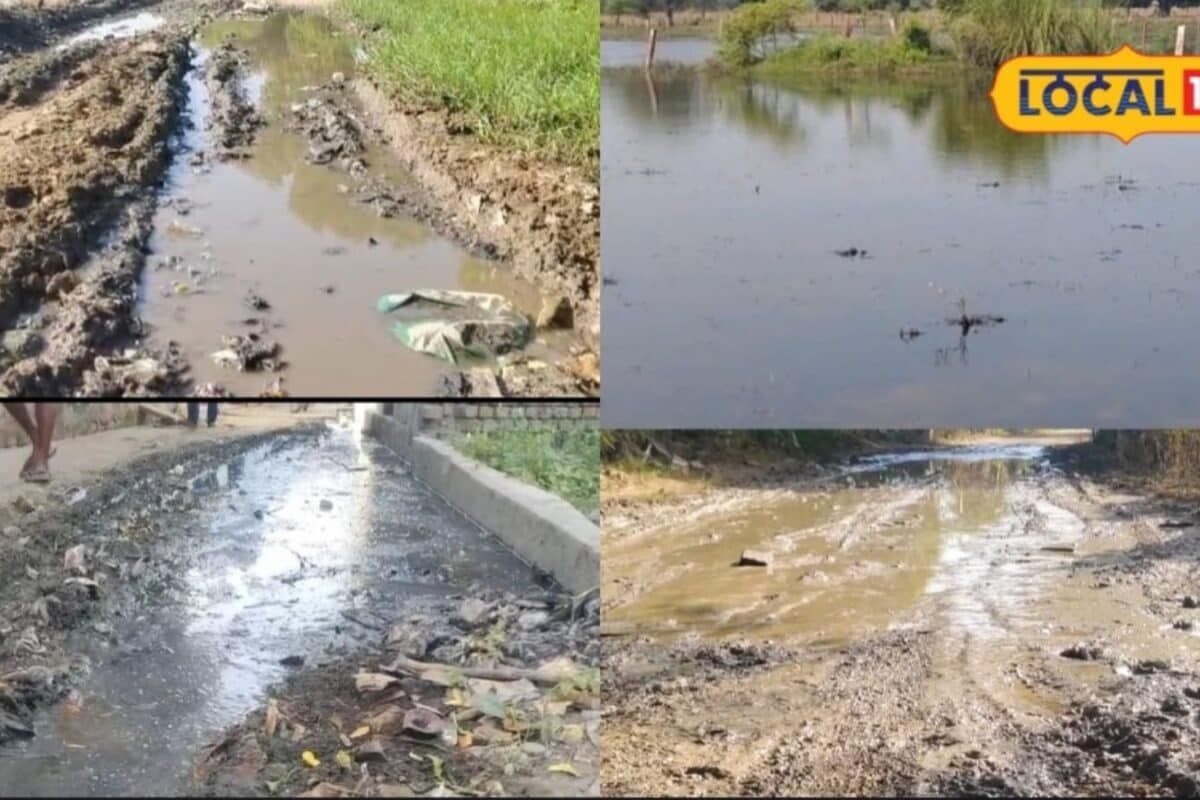
In the rural heartland of Dholpur district, a severe ecological and humanitarian crisis has unfolded in Bhaisakh-Samola village, where farming families are enduring immense distress. For an extended period, the livelihoods of local agriculturists have been directly threatened by the persistent inflow of hazardous and untreated wastewater. This unfortunate situation has turned fertile agricultural fields into stagnant pools of contaminated liquid, rendering the soil completely uncultivable and shattering the economic backbone of the agrarian community.
Tracing the origin of this grave predicament, affected residents report that the problem has persisted unabated for the past two years. The continuous discharge originating from the direction of Dholpur city has systematically found its pathway into the agricultural territory of Bhaisakh-Samola village. What began as an occasional overflow has transformed into a perennial deluge of foul-smelling, toxic sewage, disrupting the traditional farming calendar and devastating rural ecosystems that took generations to cultivate.
The quantitative impact of this disaster is staggering, with current assessments indicating that roughly 200 to 300 bighas of prime agricultural land are presently submerged. In specific pockets, the extent of inundation severely affects up to 300 bighas of crop-producing terrain. Hard-working farmers who invested their limited capital into seeds, fertilizers, and manual labor watched helplessly as their entire harvest rotted away under layers of toxic sludge, leaving them with mounting debts and zero agricultural output.
Voicing their profound grievances, local villagers and landowners state that repeated appeals directed toward local authorities have yielded no concrete relief. The unbearable stench emanating from the stagnant sewage has also raised serious health concerns, creating a breeding ground for vector-borne diseases that threaten both human and livestock populations. Farmers point out that the agricultural land, which once produced abundant yields to sustain their families, now stands as a stark symbol of official apathy and infrastructural neglect.
Beyond the agricultural devastation, the infrastructural landscape of Bhaisakh-Samola village paints an equally dismal picture of deprivation. Residents highlight that the much-touted Jal Jeevan Mission has failed to materialize on the ground, leaving households without functional tap water connections. Consequently, villagers are forced to travel considerable distances under difficult circumstances merely to procure basic drinking water for daily survival.
Compounding these hardships, the internal infrastructure of the settlement remains severely compromised, with dilapidated roads, non-functional drains, and erratic electricity supplies plaguing daily existence. The combination of ruined farmlands and absent civic amenities has isolated the community, severely restricting economic mobility and access to essential services. Local inhabitants express deep frustration that basic developmental promises have remained confined to paper while their living conditions deteriorate daily.
Looking ahead, the affected farming community of Bhaisakh-Samola demands immediate administrative intervention, comprehensive compensation for their ruined crops, and urgent engineering solutions to divert the toxic sewage away from their agricultural lands. Without prompt corrective measures from district authorities, the socio-economic fabric of the village faces permanent ruin, threatening the future generations who depend entirely on this soil for their sustenance.