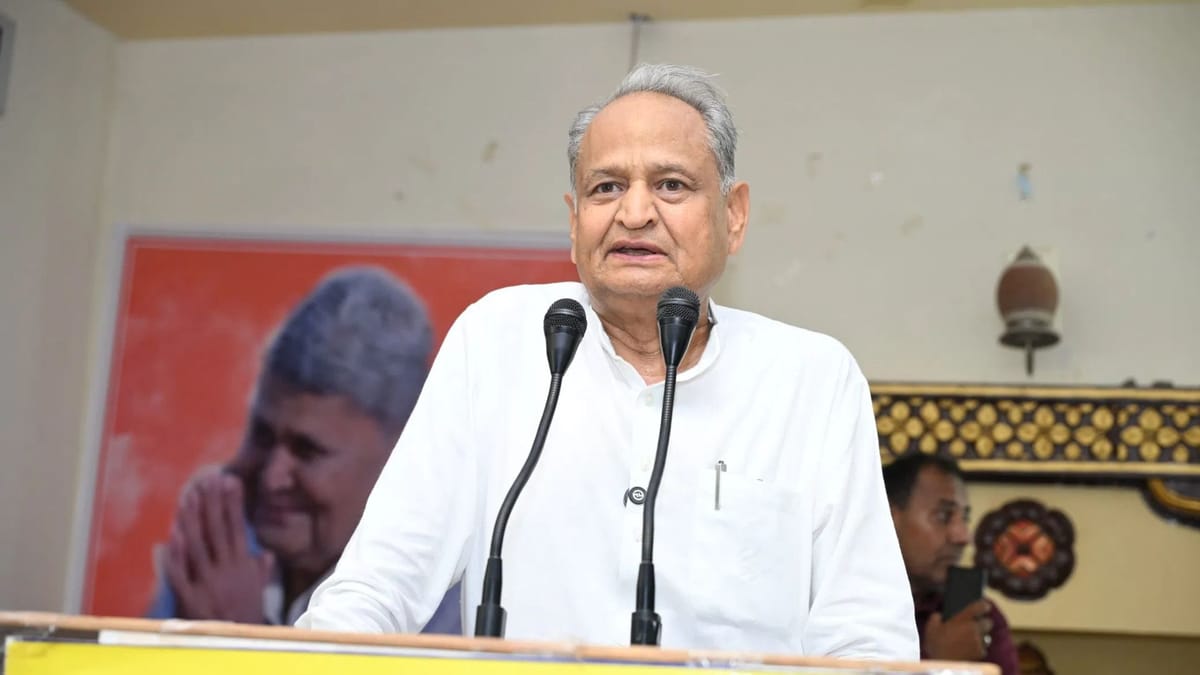
Former Chief Minister Ashok Gehlot has launched a comprehensive and sharp counter-response against the allegations made by BJP national leader Nitin Nabin, directly targeting the central government over its administrative and political approaches in Rajasthan. This significant political development has immediately drawn the attention of political analysts and citizens across the state, marking a renewed escalation in verbal exchanges between the primary rival political factions.
The current political friction traces its origins to recent statements and accusations leveled by the Bharatiya Janata Party leadership, specifically involving Nitin Nabin, against the former state administration. In response to these critiques, Ashok Gehlot stepped forward to defend his governance record while expanding the scope of his political criticism to question the overarching policies and performance of the central government.
While addressing the core issues raised during the ongoing political discourse, various stakeholders and political observers have noted that administrative accountability and policy implementation remain central to the debate. The back-and-forth rhetoric emphasizes differing viewpoints on resource allocation, governance effectiveness, and the fulfillment of public promises made by respective authorities at both state and national levels.
Community members, local political workers, and residents within the Kotputli-Behror region and wider Rajasthan are closely monitoring these high-level political developments. The regional economy and daily public discourse often reflect the ripples of such intense statewide political exchanges, as citizens deliberate upon the performance and credibility of national and regional leadership figures.
Administrative oversight and statutory responses from respective party apparatuses continue to shape the trajectory of this political debate. Officials from both political camps are actively engaging with party cadres and the public to reinforce their respective narratives and build support ahead of future political milestones and civic engagements.
Looking forward, political analysts anticipate that this ongoing tussle between Ashok Gehlot, the Bharatiya Janata Party, and the central administration will remain a dominant feature of Rajasthan's political landscape. Upcoming political timelines and public meetings are expected to witness further clarifications and counter-arguments as both sides vie for public approval and electoral advantage.
As the dialogue between these prominent political figures evolves, the electorate in Rajasthan continues to weigh the arguments presented by both the opposition and the ruling establishment, underscoring the dynamic and competitive nature of democratic governance in the region.