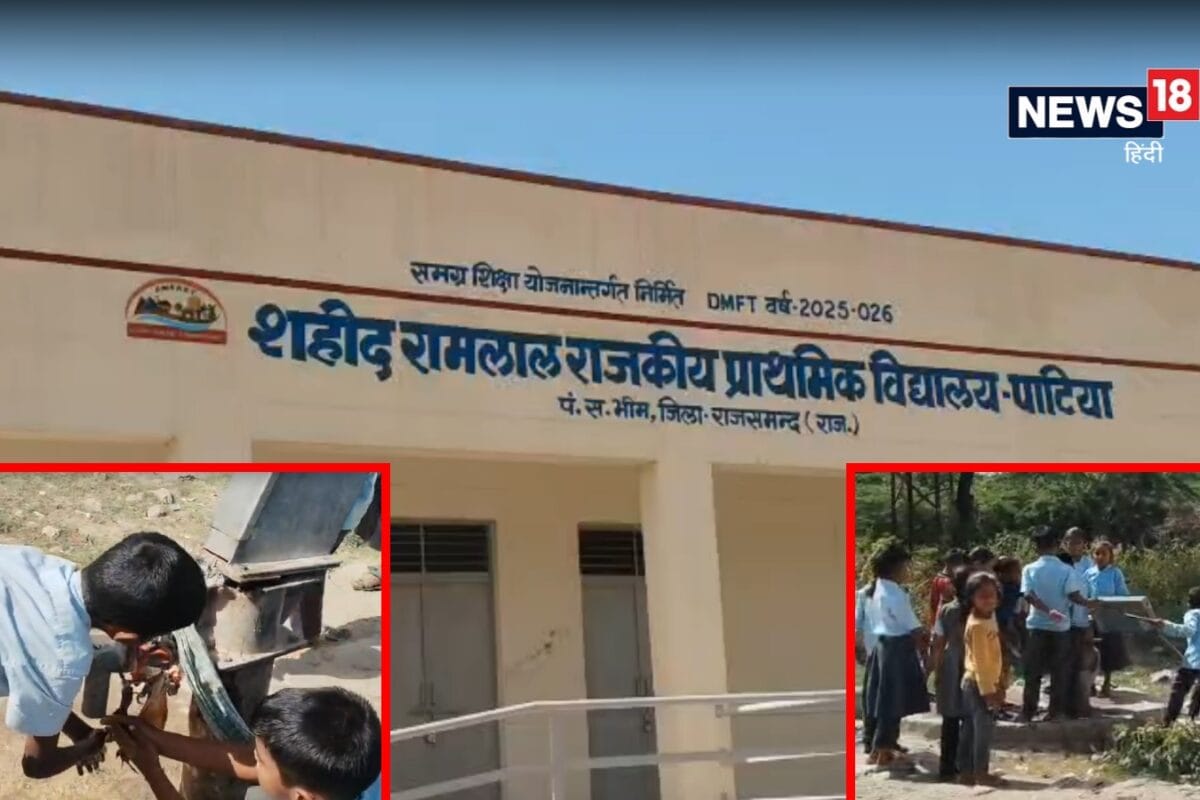
In an alarming development highlighting the persistent neglect of rural educational infrastructure, a deeply concerning video has emerged from Shahid Ramlal Government Primary School, located in Patia village within the Bhim region of Rajsamand district. The widely circulated visual documentation captures young, vulnerable school children striving strenuously to operate a completely broken handpump just to secure basic drinking water, followed by harrowing scenes of these same young students washing their own food plates after meals. This disturbing episode underscores a profound systemic failure in providing safe, functional, and hygienic environments within state-run primary educational institutions.
The genesis of this crisis traces back to systemic infrastructural deterioration and chronic administrative apathy plaguing remote rural outposts in Rajasthan. Educational institutions such as Shahid Ramlal Government Primary School in Patia are mandated to function as safe havens of learning and holistic child development, yet they frequently struggle with abysmal maintenance budgets and zero preventive upkeep. Over successive fiscal periods, local authorities have repeatedly failed to allocate timely resources for emergency repairs of essential facilities like deep-bore handpumps, sanitation blocks, and mid-day meal cleansing stations, leaving students and understaffed teaching faculty completely stranded.
A granular examination of the ground reality at the Patia facility reveals severe logistical stakes that directly endanger child health and public welfare. The complete malfunction of the primary water source forces young children to exert themselves physically in unsafe conditions, risking dehydration, physical strain, and waterborne illnesses. Furthermore, requiring primary school children to manually scrub and cleanse their own dining utensils violates standard health protocols and mid-day meal scheme guidelines, which explicitly mandate hygienic institutional arrangements for food preparation, distribution, and post-meal sanitation to prevent gastrointestinal infections among students.
Community members, local guardians, and education rights advocates have expressed profound outrage over the deplorable conditions documented at the Rajsamand school. Frustrated parents have voiced serious concerns regarding the safety and well-being of their children, pointing out that repeated verbal complaints submitted to local educational functionaries regarding the broken handpump and sanitation deficits fell on deaf ears prior to the digital emergence of the viral video. Local traders and community elders argue that administrative negligence of foundational public infrastructure severely undermines the fundamental right to education guaranteed to rural children.
While this specific incident unfolded within the administrative boundaries of Bhim in Rajsamand district, the broader socio-economic and institutional ramifications resonate across the entire state, including developing regions like Kotputli-Behror. Across rural Rajasthan, economic productivity and community stability depend heavily on functional public institutions that alleviate the daily burdens of rural families. When basic public schools fail to provide clean drinking water and sanitary dining conditions, working-class parents face compounded distress, forcing them to contemplate costly private schooling alternatives or compromise entirely on their children's foundational education.
In response to the mounting public pressure and the undeniable evidence presented by the viral footage, district educational administrators and regional authorities have reportedly initiated preliminary inquiries into the affairs of Shahid Ramlal Government Primary School in Patia. Statutory oversight mechanisms require immediate remedial action, including the dispatch of specialized technical teams to repair or replace the broken handpump and the immediate deployment of support staff to handle institutional sanitation and meal clean-up procedures, thereby relieving young students of improper labor.
Looking toward the future, education experts and public accountability groups emphasize that sporadic, reactive measures in the wake of viral social media scandals are entirely insufficient to safeguard rural schooling. A comprehensive, time-bound audit of all government primary schools across Rajsamand, Bhim, Patia, and neighboring administrative jurisdictions is urgently required to identify non-functional water points and sanitary hazards. Public expectations remain high that district authorities will establish permanent, transparent maintenance protocols to ensure that no child in rural Rajasthan is ever again subjected to unsafe infrastructure and improper domestic chores within the sacred premises of a learning institution.