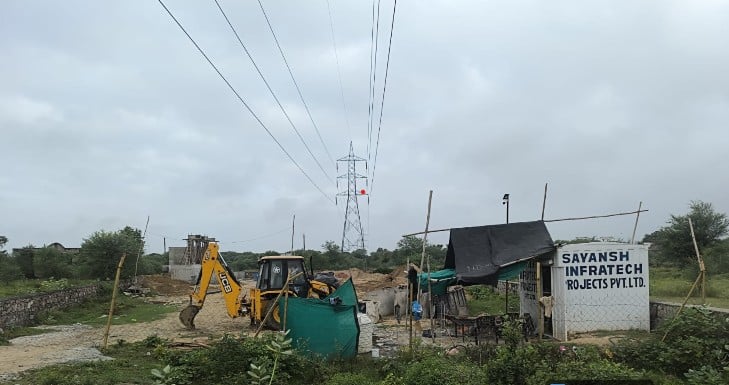
In a significant legal development addressing critical urban infrastructure safety, the Rajasthan High Court has initiated formal proceedings concerning the controversial construction of a pumping station situated directly beneath a live high-tension electricity network in Jaipur. The judicial intervention comes in the wake of a public interest litigation filed before the court, which highlights severe potential safety hazards, regulatory violations, and administrative oversight associated with executing such heavy civil engineering projects in close proximity to major power transmission arteries.
The genesis of this judicial scrutiny traces back to growing public concerns over urban planning oversights, where civic infrastructure projects are frequently initiated without adequate preliminary safety clearances or adherence to mandatory clearance zones. High-tension electricity grids, specifically high-voltage power networks, require strictly maintained vertical and horizontal spatial buffers to prevent catastrophic electrical hazards, accidental electrocution, and infrastructure failure. Constructing public utilities such as water pumping stations within these designated danger zones directly contravenes established safety codes and statutory electricity regulations.
At the center of the ongoing legal inquiry are critical technical specifications and infrastructural parameters, most notably the active presence of the 220 KV high-tension line running directly above the construction site. The involvement of massive machinery, deep excavation works, and constant human deployment for the pumping station operations creates an environment of extreme occupational and public hazard. Legal counsels representing the petitioners have placed detailed technical objections before the bench, emphasizing the immense financial and human risks involved if an electrical fault or catastrophic line failure occurs at the location.
During the preliminary hearings, various stakeholders, including local governance advocates, concerned citizens, and civic planning experts, voiced serious apprehensions regarding the lack of inter-departmental coordination between municipal bodies and power transmission agencies. The public interest litigation demands strict accountability from the civic authorities who sanctioned the project site without factoring in the grave dangers posed by the overhead transmission wires, thereby prioritizing expediency over public safety and statutory compliance.
The ramifications of this judicial case extend significantly across the entire Jaipur region and neighboring administrative districts like Kotputli-Behror, where infrastructural expansion projects are frequently scrutinized for environmental and safety compliances. Local residents and regional communities closely monitor these legal developments, as any strict judicial precedent established by the high court will directly impact how municipal and utility corporations design, approve, and execute civic infrastructure near heavy electrical installations in the future.
Responding to the gravity of the constitutional and safety concerns raised in the petition, the judiciary has formally issued strict directives to the administration. The bench has explicitly mandated the transmission corporation, specifically the Rajasthan Rajya Vidyut Prasaran Nigam Limited (RVPNL), to submit a comprehensive, well-documented official response addressing all technical, legal, and safety aspects of the ongoing construction within the stipulated timeframe.
As the legal proceedings progress, all eyes remain fixed on the upcoming administrative submissions and the subsequent judicial orders. The court has granted a strict window of six weeks for the respondents to file their detailed replies, setting the stage for a thorough legal review that could potentially halt the hazardous construction or mandate rigorous structural and geographical relocations to safeguard public well-being.