
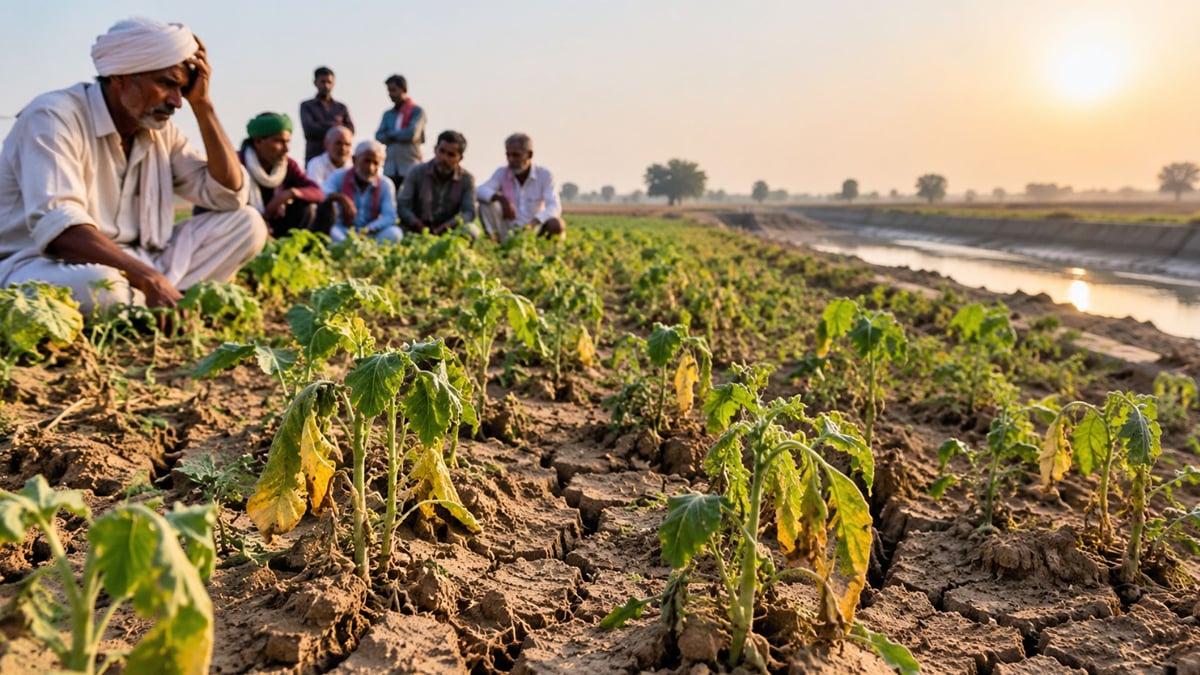
In the Anupgarh branch region of Rajasthan, an unfolding agricultural crisis has pushed the farming community to the brink of despair. Due to a severe lack of canal water coupled with an unrelenting heatwave, newly sprouted mustard crops have begun to wither away in the fields. This alarming development threatens the livelihoods of numerous farmers who depend entirely on timely irrigation to nurture their crops through the vulnerable early stages of growth, raising profound concerns about overall agricultural productivity in the region.
The current emergency is deeply rooted in systemic water distribution issues that have long plagued the command area. The region relies heavily on canal networks to sustain winter and transitional crops, making water availability a matter of absolute survival for the agrarian economy. Over recent seasons, irregularities in water supply have aggravated tensions between farming communities and water management authorities, setting the stage for sustained unrest and widespread dissatisfaction among cultivators who watch their hard work go to waste.
As the crisis deepens, the ground reality reflects staggering logistical and financial stakes for the local population. The ongoing agitation by farmers, which has now entered its 44th day, demonstrates the depth of their desperation and resolve. Day after day, cultivators have gathered to demand immediate and adequate water releases from the administration, pointing out that every single day of delay inflicts irreversible damage on the mustard plants that require moisture for healthy germination and subsequent vegetative growth.
Throughout this 44-day period of protest, farmers have consistently voiced their anguish over administrative apathy and the failure to secure reliable irrigation schedules. Community representatives and agricultural leaders have underscored that the current conditions are unprecedented in their severity, threatening not only immediate crop yields but also the financial stability of farming households. Traders and local market participants are also monitoring the situation closely, as reduced crop output directly impacts regional commerce and economic circulation.
While the immediate epicenter of the agitation is the Anupgarh region, the broader implications resonate across the wider administrative geography, touching communities that share economic ties with the agrarian heartland. The struggle for water highlights the vulnerability of regional farming systems to climatic extremities and infrastructural bottlenecks. The economic shockwaves generated by withered mustard fields extend far beyond individual farms, affecting rural employment, purchasing power, and local market dynamics.
In response to the mounting pressure from the sustained protests, administrative authorities and local officials are under intense scrutiny to address the grievances of the farming community. Stakeholders are engaged in continuous dialogues to explore potential mitigation measures within the existing water-sharing frameworks. However, the complex nature of canal distribution schedules and upstream availability constraints means that immediate relief remains a formidable challenge for the district administration.
Looking ahead, the immediate hopes of the farming community are pinned on the upcoming operational cycle. Farmers across the Anupgarh branch region are eagerly counting down the days until the crucial date of October 29, when the next scheduled water turn is expected to arrive. Whether this upcoming allocation will arrive in time to salvage the remaining mustard plants and bring a peaceful resolution to the 44-day movement remains the central question on the minds of every grower in the region.
