
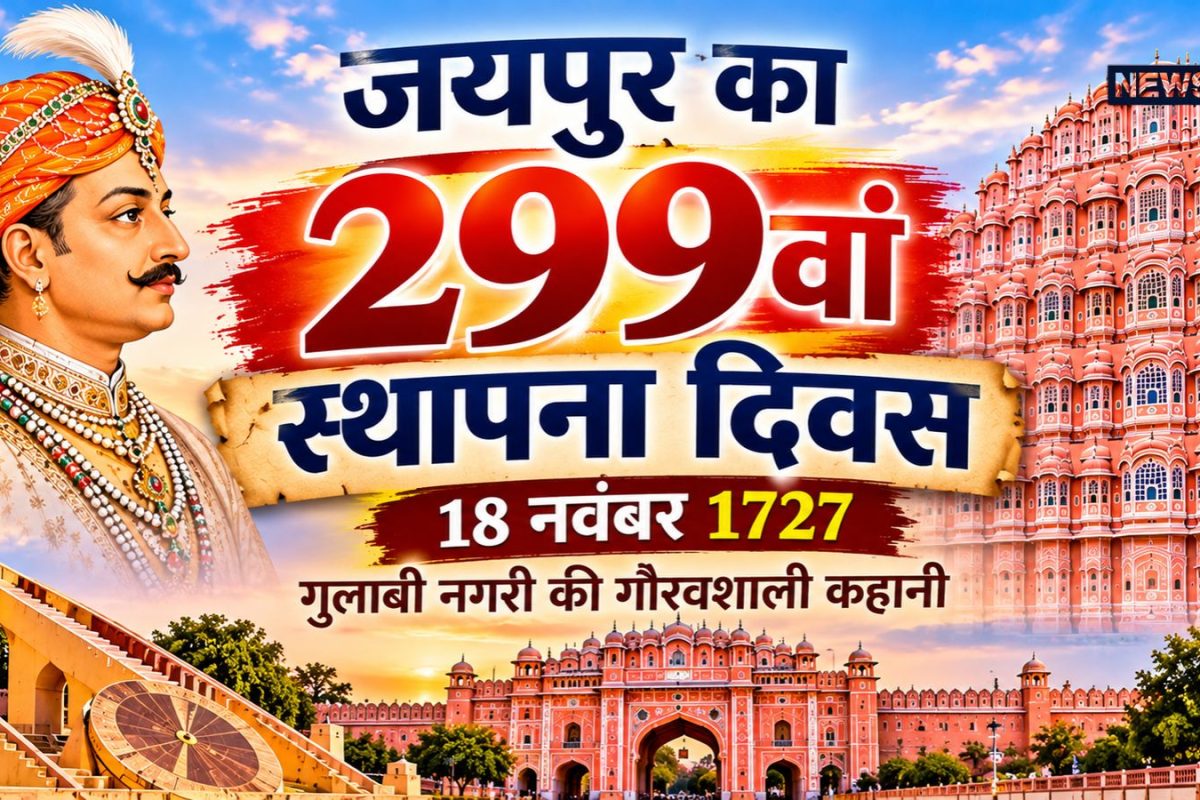
Jaipur, the magnificent capital city widely celebrated as the Pink City, is observing its momentous 299th foundation day, marking nearly three centuries of glorious history, architectural mastery, and cultural vibrancy. Established formally on November 18, 1727, by the visionary ruler Sawai Jai Singh II, the city has evolved from a meticulously planned desert settlement into a globally renowned metropolis. This historical milestone invites residents, historians, and tourists from across the globe to reflect upon the enduring legacy and structural ingenuity that defines the identity of Jaipur today.
The foundational history of Jaipur is deeply rooted in advanced urban planning and astronomical precision, conceptualized by the brilliant Bengali architect Vidyadhar Bhattacharya under the direct patronage of Sawai Jai Singh II. Breaking away from the haphazard and fortified layouts typical of medieval cities, Bhattacharya designed Jaipur based on the ancient Hindu architectural treatise of Vastushastra, incorporating the nine grids or nine sectors known locally as 'chowkadis'. This unique nine-fold layout corresponds directly to the cosmic Navagraha concept, aligning urban development with celestial harmony and ensuring seamless trade, defense, and residential zoning.
Examining the ground realities of the historical walled city reveals remarkable architectural and logistical statistics that continue to baffle modern urban planners. The city's master plan integrated seven massive historic gates, which served as heavily fortified entry and exit points regulating commerce and security. Within these boundaries, iconic monuments like Jantar-Mantar—a monumental UNESCO world heritage astronomical observatory equipped with massive precision instruments—and the towering seven-storied Chandra Mahal stand as eternal testaments to the scientific curiosity and aesthetic grandeur of the bygone era.
Local artisans, traders, and cultural stakeholders consistently emphasize the profound economic and vocational stakes tied to the city's living heritage. Renowned commercial hubs like Johari Bazaar remain famous worldwide for their exquisite gemstone cutting and mehakari work, while Tripolia Bazaar continues to thrive as the primary center for traditional lac bangles. These vibrant markets support thousands of local families, master craftsmen, and generational artisans whose specialized skills are preserved and transmitted through centuries of unbroken tradition, attracting discerning buyers and international tourists.
The cultural and economic resonance of Jaipur extends far beyond its immediate municipal boundaries, significantly influencing neighboring districts including Kotputli-Behror. As a major metropolitan anchor within Rajasthan, Jaipur serves as the primary economic engine, educational hub, and cultural epicenter for surrounding rural and semi-urban communities. Residents from Kotputli-Behror frequently engage with Jaipur's commercial markets, traditional festivals like Gangaur and Teej, and administrative institutions, creating a closely knit regional ecosystem of mutual economic interdependence.
Recognizing the immense responsibility of preserving this fragile historical ecosystem, municipal and state administrative bodies maintain strict oversight and regulatory frameworks to protect the walled city's architectural integrity. Conservation projects focus on maintaining the characteristic pink facade, regulating commercial encroachment, and upgrading civic infrastructure to accommodate millions of annual visitors without compromising the ancient layout. Statutory authorities actively coordinate with heritage conservationists to ensure that modern development aligns seamlessly with the historical guidelines laid down nearly three centuries ago.
Looking forward, as Jaipur steadily approaches its monumental tricentennial anniversary, public expectations and administrative planning are pivoting toward sustainable heritage tourism and smart urban regeneration. Upcoming municipal programs aim to restore deteriorating facades, enhance public spaces around the seven historic gates, and promote indigenous crafts such as Sanganeri prints and blue pottery on international digital platforms. Through a balanced approach combining modern civic amenities with deep-rooted historical respect, Jaipur stands poised to protect its invaluable heritage for generations to come.
