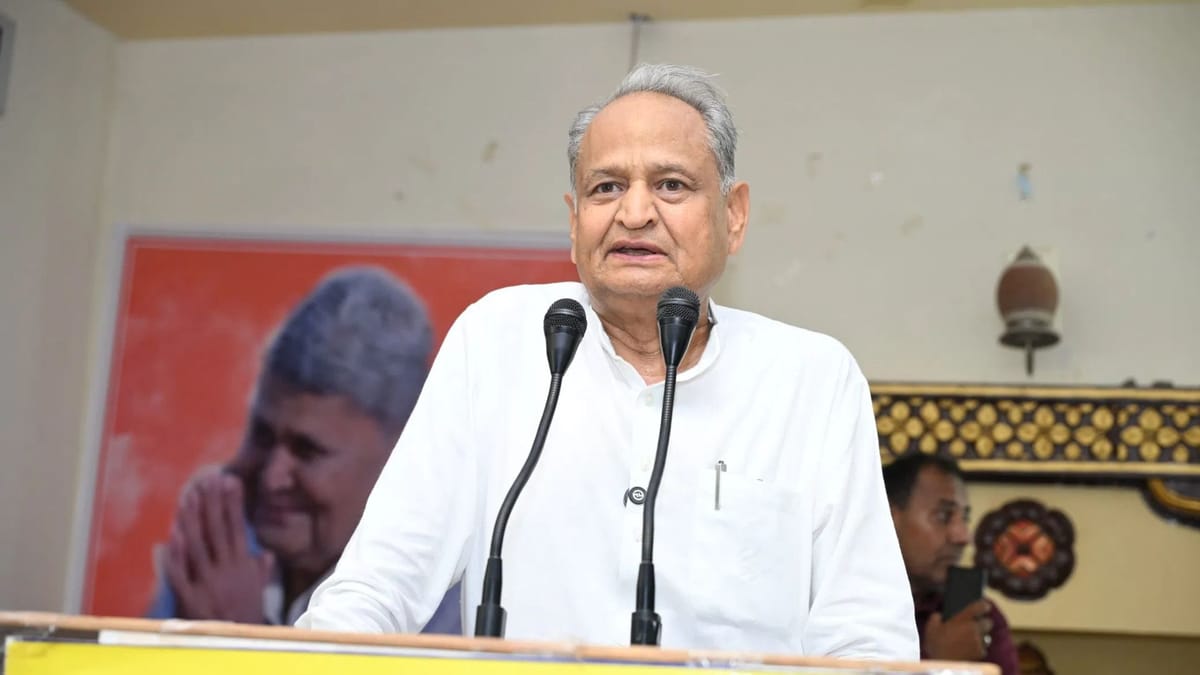
In the wake of upcoming panchayat elections across Rajasthan, former Chief Minister Ashok Gehot has formally responded to a controversial statement made by Chief Minister Bhajanlal Sharma regarding farmers. The political atmosphere in the state has intensified considerably as agrarian issues take center stage in the regional discourse. Both prominent leaders are currently engaging in a war of words that is expected to heavily influence the rural voter base.
The historical context of agrarian politics in Rajasthan reveals a persistent tension between ruling administrations and agricultural communities. Over successive legislative terms, policy decisions regarding irrigation, minimum support prices, and electricity subsidies have remained contentious subjects. Chief Minister Bhajanlal Sharma's recent remarks have reignited these historical grievances, prompting strong opposition reactions across the administrative machinery and political spectrum.
While specific statistical data regarding the exact logistics of the impending panchayat elections are still being formulated by the state election commission, the economic and social stakes for rural communities remain remarkably high. Farming populations across various districts depend heavily on state policy support for their seasonal crop yields, making governmental rhetoric a matter of critical livelihood concern rather than mere political posturing.
Stakeholder perspectives from various agricultural unions and local farming communities indicate mounting frustration regarding governance priorities. Representatives of farming bodies have expressed solidarity with Ashok Gehot's assessment, warning that administrative apathy towards rural distress will translate directly into electoral repercussions. Conversely, supporters of Chief Minister Bhajanlal Sharma maintain that current administrative policies are designed to bring long-term fiscal stability and infrastructural modernization to the agricultural sector.
Within the newly established administrative boundaries of the Kotputli-Behror region and surrounding areas, local economies are uniquely sensitive to these political developments. Agricultural trade, cooperative societies, and local mandis are experiencing heightened anxiety as political rhetoric escalates. Community leaders in Kotputli emphasize that rural livelihoods require constructive policy dialogue rather than escalating partisan disputes during the pre-election phase.
Administrative oversight bodies and district governance machinery are closely observing the unfolding political dynamics to maintain law and order as the electoral timeline approaches. District authorities have reiterated their commitment to ensuring a free, fair, and peaceful electoral process for the upcoming panchayat polls. Statutory guidelines are being strictly enforced to prevent any potential escalation of political tensions during public gatherings and campaign rallies.
Looking forward, the political trajectory in Rajasthan points toward a fiercely contested electoral battle in the upcoming panchayat elections. As former Chief Minister Ashok Gehot intensifies his outreach regarding the farmer issue, the ruling administration will undoubtedly face increased pressure to justify its policy record. Observers anticipate that rural voters will utilize the ballot box to register their final verdict on these competing political narratives in the weeks ahead.