
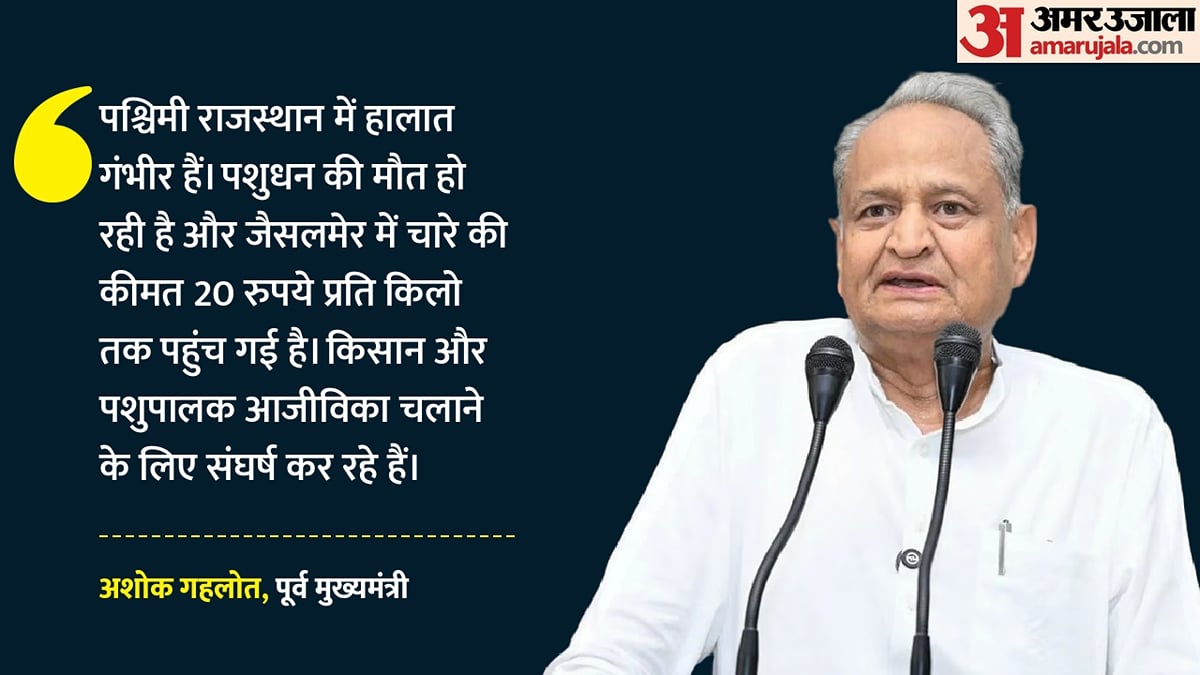
Former Chief Minister Ashok Gehlot has strongly criticized the current administration in Rajasthan, led by the Bhajanlal government, over the escalating crisis of drought and the severe scarcity of fodder for livestock across the state. The worsening agrarian conditions have sparked serious concerns among agricultural communities, prompting the senior political leader to demand immediate administrative intervention to alleviate the mounting distress.
The current agricultural and environmental distress in Rajasthan stems from delayed or deficient seasonal patterns, leading to parred farmlands and failing crops. Historically, regions across the state have experienced recurrent dry spells, making timely governmental response and proactive contingency planning absolutely vital for the survival of millions of rural households whose livelihoods depend entirely on agriculture and animal husbandry.
On the ground, the situation has translated into alarming challenges for livestock owners and farmers, who are struggling to secure adequate water supplies and nutritional fodder for their animals. The economic stakes are exceptionally high, as the rural economy heavily relies on cattle and livestock production, meaning that a prolonged shortage directly threatens the financial stability of farming families across the region.
Voicing deep concern over the apathy shown toward the suffering public, Ashok Gehlot remarked that if divine forces turn away, it is understandable, but the elected government must never abandon its people. This powerful critique emphasizes the fundamental moral and administrative responsibility of the ruling authorities to stand firmly with citizens during times of natural calamity and severe hardship.
The agrarian crisis casts a long shadow over local economies, including communities in and around Kotputli-Behror, where farmers and livestock rearers face identical vulnerabilities due to depleting resources. The disruption in the agricultural cycle ripples through local markets, impacting trade, employment, and the overall socio-economic fabric of rural and semi-urban townships alike.
In response to the escalating crisis, political and community leaders are mounting pressure on the administration to initiate comprehensive relief measures. Demands include the deployment of revenue teams for immediate crop damage assessment, known locally as girdawari, to accurately quantify the losses suffered by cultivators across affected districts.
Looking ahead, public expectations center on swift executive decisions regarding the formal declaration of drought and the subsequent rollout of financial assistance. Stakeholders across the state await transparent administrative timelines to ensure that adequate fodder depots and water tankers are mobilized before the situation deteriorates further into an unprecedented humanitarian crisis.
